
There is something rather amusing about celebrating a website’s rising organic traffic while the sales pipeline remains stubbornly unimpressed. The rankings look good, the analytics dashboard is having a lovely time, and marketing has another success story for the monthly report. Meanwhile, prospective buyers arrive on the website, look around briefly and disappear into the internet, presumably to find someone who makes the next step easier.
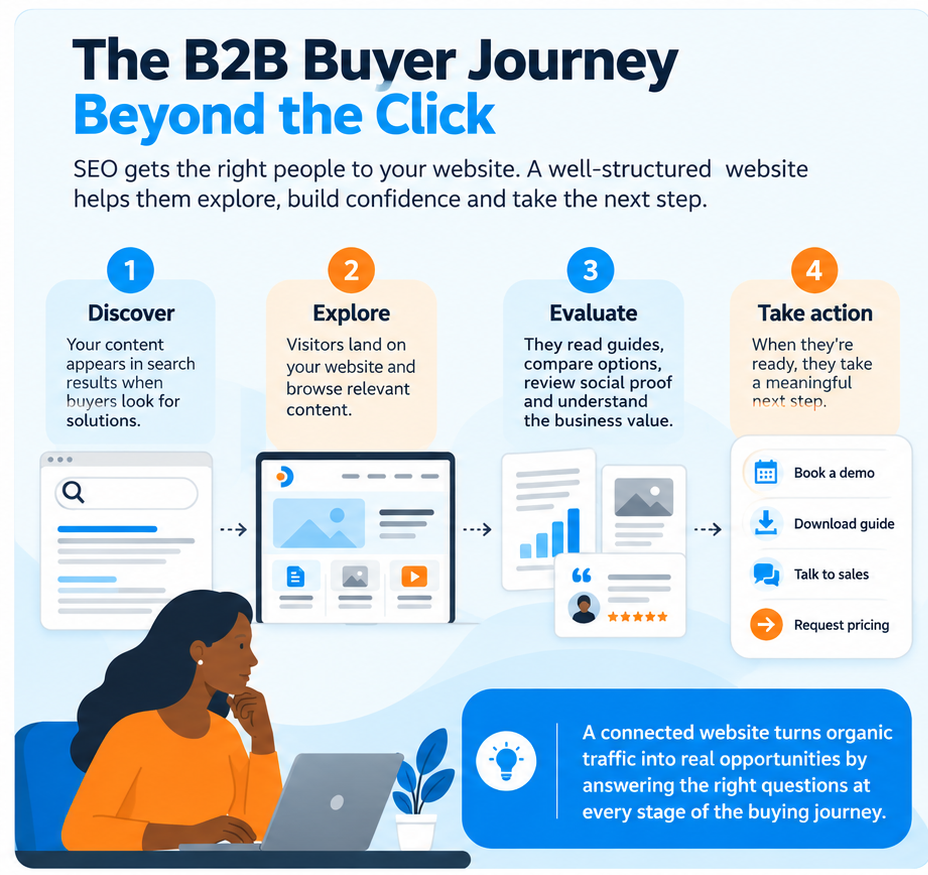
I think this is where we need to rethink our approach to B2B SEO strategies. Getting discovered matters, of course, but discovery is only the beginning of the relationship. The real opportunity lies in what happens after someone clicks through: whether the website answers their questions, builds confidence and helps them move closer to a decision.
For marketers, that means looking beyond search visibility and considering how SEO, website experience and demand capture work together.
Your Website Should Do More Than Make a Good First Impression
I like to think of a B2B website as a salesperson who works around the clock but never gets to assume the visitor is ready to buy. Some people arrive trying to understand a problem; others are comparing solutions, evaluating risks or quietly gathering evidence to justify a purchase to their boss.
A website that treats every visitor as a potential demo booking is likely to miss these differences. Equally, a website that offers endless educational content without helping people understand the commercial solution has its own problems.
I would start by asking a simple question: what does a prospective buyer need to understand next? An educational article might lead to a relevant solution page, which could lead to an implementation guide, customer example or product demonstration. Each page should have a purpose within that journey, rather than existing simply because someone found another keyword to target.
The goal is to make the next useful step obvious without making the visitor feel as though they have walked into a sales ambush.
Connect Your Content Before You Create More of It
When organic performance disappoints, the instinct is often to publish more content. I understand the temptation; a new article feels like progress, and a content calendar with plenty of activity looks reassuringly productive. But more pages do not automatically create a better buying experience.
I would pay closer attention to how existing pages work together. Can someone reading an article about a business challenge easily find the relevant solution? Can a visitor comparing approaches discover the technical information or implementation details needed to evaluate the offer?
Internal links can do more than help search engines discover pages. They can help buyers move between related questions without repeatedly returning to search results to piece the story together themselves.
This is also where I would think beyond the person conducting the initial search.
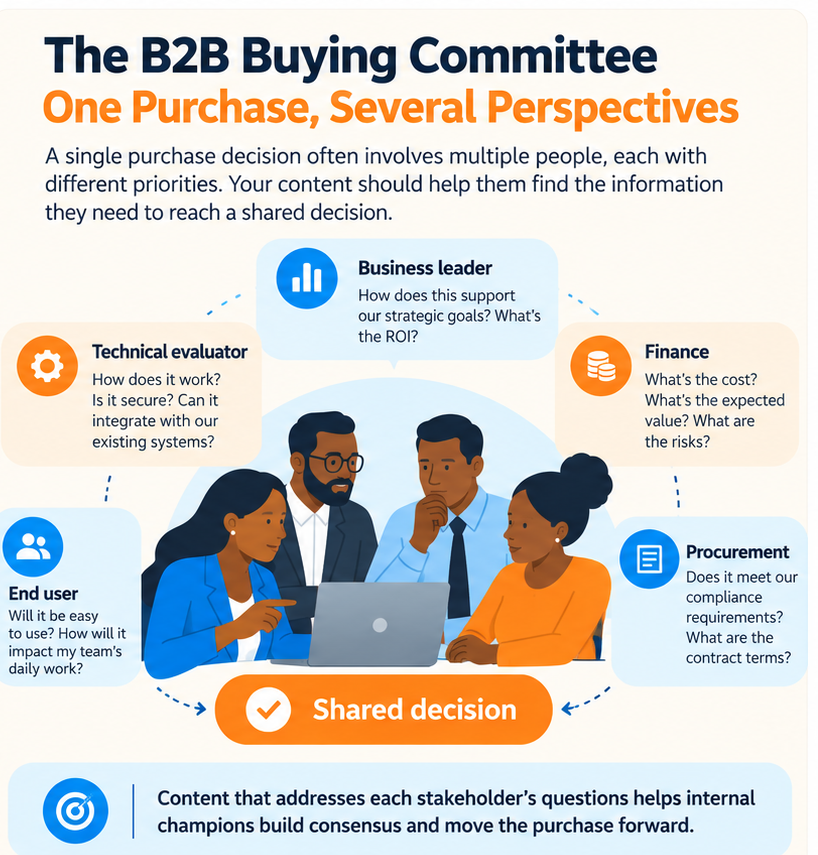
Gartner reported in May 2025 that 74% of B2B buying teams demonstrate unhealthy conflict during the decision process, with disagreements over objectives, competing views on the best solution and external decision-makers overruling the group all contributing to the problem. For marketers, this reinforces the importance of creating content that helps internal champions explain the business case, address technical concerns and build agreement across the buying committee.
For me, a strong content architecture is not merely an SEO consideration. It is part of how marketing helps a buying decision happen.
Make the Next Step Match the Buyer’s Readiness
Once the content journey makes sense, I would examine what we ask visitors to do. The familiar “Book a demo” button has earned its place on many B2B websites, but it cannot be the answer to every commercial question.
Someone researching a problem may be more comfortable exploring a practical guide. Someone comparing vendors may want to understand implementation requirements, product capabilities or expected outcomes. A buyer who has already evaluated the options might be ready to request pricing or speak to sales.
I would align calls to action with these different needs, giving visitors a meaningful next step without demanding more commitment than they are ready to make.
This also means reconsidering how we measure success. A visitor who reads a technical guide and returns weeks later to request a consultation may be more valuable than someone who clicks a prominent CTA immediately but never qualifies. If we only reward the last interaction, we risk overlooking the content that helped build confidence along the way.
Guys, the point is not to make conversion tracking unnecessarily complicated. It is to stop treating every conversion as though it carries the same commercial meaning.
Build for Search Visibility and AI Discovery
The way buyers discover information is evolving, and I would be careful not to treat generative engine optimization (GEO) as an entirely separate discipline requiring a mysterious new collection of tricks.
Google's guidance maintains that established SEO fundamentals remain relevant to its AI search experiences, including accessible content, helpful information and clear site structure.² For marketers, I see this as a reason to strengthen the quality of what we already publish rather than chase every new optimization trend.
If a company wants to be recognized as a credible source, its content needs to offer something worth recognizing. That could mean original analysis, a useful explanation of a complex issue, a thoughtful comparison or practical expertise that goes beyond repeating what ten competing websites have already said.
I would also make sure important information is clearly presented on the page, supported by appropriate evidence and easy for readers to navigate. A well-structured article cannot guarantee an AI citation, just as sound SEO cannot guarantee a ranking, but useful and distinctive content gives both human readers and search systems more substance to work with.
The strategic question is whether your content contributes something meaningful to the conversation or simply adds another page to an already crowded search result.
Measure the Business Journey Not Just the Traffic
Finally, I would connect SEO reporting more closely to commercial outcomes. Rankings, impressions and organic sessions still matter because they help explain visibility and discovery, but they cannot tell the whole story.
I would look at how priority pages contribute to engaged visits, meaningful conversion actions, qualified leads and sales opportunities, using CRM data and other marketing touchpoints to understand the wider journey. Because B2B purchases often involve several stakeholders and multiple interactions, I would avoid assuming that the last click deserves all the credit.
I would also use these insights to make better decisions about where to invest next. If a page attracts relevant visitors but rarely moves them towards another useful action, I would investigate its content, links and conversion path before commissioning five more articles on the same subject.
That is how SEO becomes a connected part of go-to-market strategy rather than a channel reporting impressive numbers in isolation.
Related reading: How SEO Content Clusters Draw in the Audience and Skyrocket Conversions, Podcast SEO is the New Frontier for Content Marketers and How to scale organic search growth for profits through SEO Automation
Final Words
The B2B SEO strategies I would prioritize are the ones that connect discovery to decision-making. I want a website that attracts the right audience, helps buyers navigate their questions, supports internal conversations and makes it easier to take the next step. I also want measurement that tells me whether those efforts are contributing to meaningful business outcomes.
My starting point would be to choose one commercially important page, examine what happens after visitors arrive and identify the most useful improvement to make. Sometimes the answer is better content; sometimes it is a clearer pathway, stronger evidence or a more relevant call to action.
Because the objective is not simply to get more people through the door. It is to give the right people a good reason to stay, explore and move forward.
Want to go deeper? Listen to my podcast conversation with Sam Dunning, Sales Director and Co-Owner of Web Choice, where we explore how B2B companies can drive measurable demand through SEO, website performance and strategic content development. Sam shares practical insights on unlocking bottom-of-funnel results, improving lead quality and building brand equity through smarter organic strategies. We also discuss the shift towards zero-click content, when to gate or ungate valuable assets, and how to build content engines that continue working long after publication.